The weight of words
She wrote gothic horror about lotteries in small towns with small minds and houses on hills whom she imagined were alive. She wrote of madness and young girls trying to escape the future that awaited them. She wrote humorous short stories about being a housewife in the 1950s and the mayhem of motherhood in a life amongst savages. She wrote of the personal-is-political before the second waves of feminism had begun to move. She wrote of everyday ordinariness and made it shimmer with magical thinking. In a 1959 lecture entitled “Garlic in fiction,” American writer Shirley Jackson also wrote of strategies to engage a reader emotionally and intellectually and suggested the use of a set of no more than five “weighted words” in relation to any given character would do.

[1]Image of Shirley Jackson source: https://benningtonmuseum.org/event/oct2023bhs/”Margaret stood all alone at her first witch-burning. She had on her new blue cap and her sister’s shawl, and she stood by herself, waiting…She felt a very pleasant fear and crying excitement over the burning; she had lived all her life in the country and now…she was being introduced to the customs of society” — Shirley Jackson, Let me tell you, Preface
In her writing, Jackson uses such “artificial loading” to grow the “essence” of characters which builds a manner of speaking, a manner moving and a manner of being. Like garlic, such symbols and metaphors are splendid and irreplaceable but must be used with extreme care where they will do the most good, and not used where they will overwhelm the flavour of another passage.
There is much to learn from Shirley Jackson. Right now, I am paying attention to Shirley’s lessons on using “seasoning sparingly” in the development of fictional characters, and how this sage advice might be applied in my own writing. “There must be one basic image, or set of images, for each character in a story,” she suggests, “a fundamental symbol the writer keeps always in mind; as these images grow the character grows, and the accumulation of material and information about the image slowly makes up the character in the story.” [2]Shirley Jackson, “Garlic in Fiction,” in Laurence J. Hyman and Sarah J. De Witt (Eds.), Let Me Tell You, 2015, p. 398. For example, in The Haunting of Hill House, Eleanor’s story orbits around the themes of longing for home, searching for a place of her own and a “cup of stars” to break the spell of dullness and loneliness. The five symbols Shirley uses to develop Eleanor’s character are a little old lady who is praying for Eleanor, two stone lions, oleander bushes and roses, a white cat, and a cup of stars. These symbols dovetail with one another, weave a path between reality and unreality, and are tasked with carrying the weight of Eleanor’s loneliness and longing for a place to belong [3]Shirley Jackson, “Garlic in Fiction,” 2015, p. 404.—and by the end of the book Eleanor’s character takes ownership of their heaviness. Response-ability, relationality, return, richness; I am thinking and wondering about how to adapt this word-cooking method into the cuisine of academic non-fiction writing. As these thoughts sit steeping, the early notes suggest the device of “loading” specific words with emotional intensity holds much promise for keeping readers of our work awake, alive and paying attention. But I am fearful already that my hand has been too heavy on the saltshaker with all this talk about food and spices and flavour. Nana Barlow, my maternal grandmother, and my mother Lynette, frequently threw salt over their left shoulders in the kitchen to ward off bad luck; and so, I do I as I write. I think and wonder that Shirley Jackson would quite like that strategy, particularly given her own affinity with the ways of wise women and the wisdom she held about such ways.
The wise ways of Shirley Jackson
Let me tell you about the wise ways of Shirley Jackson. The blurb on the dust jacket of her debut novel The Road Through the Wall [4]1948b written by her husband Stanley Hyman, spoke of her as “perhaps the only contemporary author who is a practicing amateur witch, specialising in small scale black magic and fortune telling with a tarot deck.” Upon publication of “The Lottery” [5]Shirley Jackson, “The Lottery,”The New Yorker, 26 June, 1948a., this somewhat playful biography resurfaced, and the topic of Shirley’s association with black magic captured the imagination of the media. William Garland surmised in the Associated Press, “Miss Jackson writes not with a pen but a broomstick” while critics in the Times Magazine referred to her as “Virginia Werewolf.” Shirley was impressed but embarrassed by this publicity but did not hide her consuming interest in magic and the darker forces lurking at the edges of the world, often affirming her fluency in the practical application of witchcraft in everyday life.[6]Shirley Jackson, The Letters of Shirley Jackson, Laurence J. Hyman (Ed.), 2021, p. 125. While a student a college her friend Kay Turk was intrigued by Shirley’s experimentation with the occult and her attempts to conjure up the Devil [7]Judy Oppenheimer, Private Demons: The Life of Shirley Jackson, Ballantine Books, 1988, p. 49. and with fellow resident of Lima Cottage June Mirken she “got into” tarot cards, reading fortunes and playing around with voodoo dolls.[8]Judy Oppenheimer, Private Demons, 1988, p. 66. In her collection of letters, Shirley refers to making charms—“perhaps a watch in the coffee cake;”[9]Shirley Jackson, The Letters of Shirley Jackson, 2021, p. 482. using spells to drive away unwanted visitors;[10]Shirley Jackson, The Letters of Shirley Jackson, 2021, p. 266. and her fondness for black cats,[11]Shirley Jackson, The Letters of Shirley Jackson, 2021, p. 78, 111, 320, 402. black cars,[12]Shirley Jackson, The Letters of Shirley Jackson, 2021, p. 425, 545. and black mass.[13]Shirley Jackson, The Letters of Shirley Jackson, 2021, p. 42. Interviews with Shirley inevitably turned to her association with witchcraft and the witch in Shirley responded with delight as a mother to the illogic, strangeness and intuitive nature she saw and shared with her children. “My children and I wholeheartedly believe in magic”, she proudly stated, “We do not any of us subscribe to the pat cause-and-effect rules which many other people seem to use…I have a fine library of magic and witchcraft and when I have nothing else to do I practice incantations.”[14]Judy Oppenheimer, Private Demons, 1988, p. 139. Perhaps it is not surprising then that the first work I read of hers was—The Witchcraft of Salem Village. Published in 1956 and intended to be read by children Grade 6, in this work Shirley carefully narrates the facts of witch hunting and the witch trials by paying attention to the historical, political and social context of Salem Village, but not at the expense of sharing the emotion, tension, fear and horror of these events. Even though Shirley acknowledged that witchcraft had lost its power to terrify, she warned that we have exactly the same thing to be frightened of today as the people of Salem, namely, “the demon of men’s minds which prompts hatred and anger and fear, an irrational demon which shows a different face to every generation, but never gives up in his fight to win over the world.”[15]Ruth Franklin, Shirley Jackson: A Rather Haunted Life, W. W. Norton & Company, 2016, p. 360-361.
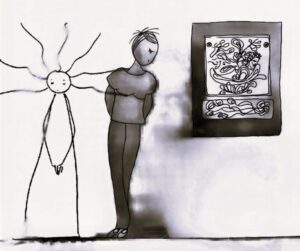
A witchy feeling[16]The line sketch of a woman included in this image is a copy of one that Shirley Jackson drew of herself, simply titled “Me”. She was fond of whimisically drawing self portraits and scenes … Continue reading
My readers heart and mind have always been drawn to writing which speaks to the her-stories, experiences and knowledges of wise women—women who drew on and passed down from generation to generation Indigenous and ancestral wisdom as healers, midwives, herbologists, botanists, agriculturalists, and astronomers; and yet, across time and place were often denigrated and persecuted as cunning folk, blessers, and witches. I cannot say why I feel this connection; in the stories that have passed down the line from my grandmothers to me, there is never any explicit mention of witches.
And yet, there is a feeling of something—a shimmer whose light slants towards something that feels like an affinity, a belonging. I remember sitting with Nana Barlow, watching her read tea leaves, hearing her remind me never to cut my nails on a Friday, never step on a crack in the footpath, cross knives, or put new shoes on the table; everyday practices I perform today. I remember standing in front of the Witches Well, a small fountain near Edinburgh Castle at the top of the Royal Mile marking the area where thousands of women accused of witchcraft were burned at the stake, wondering whether my Scottish Highland ancestors from country Caithness Margaret Miller, Anne Dunbar, Johanna Johnston or Janet Sinclair were among them. I remember that my hand instinctively moved to touch the supernumerary nipple just under my left rib cage and my eyes fell on the strawberry mark I have underneath my right forearm; blemishes I have had since birth. In that moment goose bumps jumped inside and out with the awareness that had I been alive during the 16th, 17th and 18th centuries in Scotland, these unusual skin lesions would most likely have been viewed as confirmatory evidence of being a witch in league with the devil, and I too may have been trussed and tried to burn. The shimmer I felt earlier began to shiver with an unfathomable sadness as I watched groups of people make their way towards the Castle gates, unaware that underneath the very ground they walked, the bodies of murdered women and the knowledge they held lay in ashes.
Witch hunts and modern day warfare against women
Until now, I had heard of but not engaged deeply with the writing of Italian feminist philosopher and activist Silvia Federici—I’m always astounded by the way that chance and choice come together to find the words of women that speak to the inner heart of the present moment of thinking and wondering I find myself in. She is one of the fiercest feminist word warriors I know; her intellect, insight and insisterence on the kind of just world we want to live in are quite simply awesome, in the fullest sense of the word. Silvia’s writings on witch hunting in the colonial world during the 16th and 17th centuries and contemporary witch hunts in Central Africa, India, Nepal, Papua New Guinea, and Saudi Arabia[17]Silvia Federici, Witches, Witch-hunting, and Women, PM Press. 2018, p. 4.—Caliban and the Witch: Women, the Body and Primitive Accumulation, andWitches, Witch Hunting and Women—refer to this targeted violence against women as “femicide.”[18]Silvia Federici, Witches, 2018, p. 32. She laments that because of the commercialisation of witches in popular culture, it is a history and contemporary story of a terror regime imposed on all women that has been erased from collective memory—if they could, Silvia reflects, they would continue to burn us all, emphasising that this never was and is not a game.[19]Rachel Andrews, (2022, January). Interview with Silvia Federici. The White Review. https://www.thewhitereview.org/feature/interview-with-silvia-federici/ Born in Parma, Italy in 1942, Silvia’s life work has been to make known and have acknowledged that
“such a war against women, carried out over a period of at least two centuries, was a turning point in the history of women in Europe, the ‘original sin’ in the process of degradation that women suffered in the advent of capitalism, and a phenomenon, therefore, to which we must continually return if we are to understand the misogyny that stull characterises institutional practices and male-female relations.” [20]Silvia Federici, Caliban and the Witch: Women, the Body and Primitive Accumulation, Penguin Classics, 2004, p. 175.
At the heart of this war, she insisters, violence against women was and remains a key element, lies a deep-seated fear of women’s power—the power which resides in our bodies, our labour, our communities, and our sisterhood. In her work Silvia illuminates the rich tapestry of power women once held, systematically unravelled by the cruel hands of historical and contemporary witch hunts. She underscores the vital importance of women’s control over their own reproduction, revealing how these hunts were calculated efforts to crush women’s autonomy and impose patriarchal dominance. In the days before capitalism, women were pillars of economic strength. Yet, as capitalism took root, it systematically dismantled this strength, relegating women to the shadows of unpaid domestic labour, stripping them of economic independence and binding them to dependency. Silvia also brings to light the social power women wielded, central to the fabric of community life. Capitalism’s rise tore apart these social bonds, leaving women isolated and communities weakened. She notes, “witch-hunting in all its different forms is also a powerful means to destroy communal relations, injecting the suspicion that underneath the neighbour, the friend, the lover hides another person, lusting for power, sex, wealth, or simply wanting to commit evil deeds.”[21]Silvia Federici, Witches, 2018, p. 88.
The consequences of this power theft were profound. Women were cast into economic marginalisation, social isolation, and subjected to escalating violence. Their reproductive freedom was shackled, their bodies turned into mere instruments for labour production under patriarchal and capitalist regimes. The ever-present threat of violence and the erosion of autonomy inflicted deep psychological scars, creating a pervasive atmosphere of terror that enveloped all women. Silvia poignantly captures this, stating, “even the unspeakable tortures to which the accused women were subjected acquire a different meaning when we conceive them as a form of exorcism against their powers.”[22]Silvia Federici, Witches, 2018, p. 30. She highlights that knowledge itself is power, and the witch hunts were a form of femi-epistemicide—the execution of women’s bodies was simultaneously a deliberate destruction of bodies of knowledge and wisdom held by healers, midwives, and keepers of communal knowledge, these hunts sought to eradicate women’s intellectual and spiritual authority, further entrenching patriarchal control. I walked slowly away from the Witches Well monument that day and let the tears fall, one, two and three more for each of the thousands of women brutally killed here and elsewhere around the world, asking with profound respair, “Why should women, the life-givers who bring every soul into this world, many of whom not only create but also nurture and sustain their families each day, face such an onslaught of violence, including the modern-day warfare of witch hunts?”
The magic of using seasoning sparingly
Closing the circle back to Shirley Jackson and her strategic use of “garlic in fiction,” Silvia’s exploration of the witch hunts as a means of suppressing women’s power and knowledge resonates deeply with Shirley’s writing, where she deftly uses elements of magic and psychological insight as seasonings to challenge patriarchal and capitalist constraints. I love how she expressed herself in “The real me,” a short piece where Shirley conveys her deep-seated frustration with being pigeonholed as a “trim little housewife” writing “dainty little biographical things,”[23]Shirley Jackson, “The Real Me,” in Let Me Tell You, p. 357. and resisted all conventions expected of her by fully embracing her otherworldly reputation. Whether she practiced or studied it, the female strength and potency symbolized in witchcraft was important to Shirley. [24]Ruth Franklin, A Rather Haunted Life, 2016, p. 269. An example of this is the time capsule note written by the victimized girl Marilyn Perlman in The Road Through the Wall, documenting her future aspirations: “Everyone will be afraid of me and do what I say.”[25]Shirley Jackson, The Road Through the Wall, 1948, p. 164.
Shirley wholeheartedly believed in the manifestation of such transformative and protective power in, through and with writing, and wrote, “The very nicest thing about being a writer is that you can afford to indulge yourself endlessly with oddness…So long as you write it away regularly, nothing can really hurt you.”[26]Shirley Jackson, “Memory and Delusion,” in Let Me Tell You, 2015, p. 375. She embraced this oddness by crafting sentences, paragraphs, pages, chapters and books replete with “great tenderness and chilling horror,”[27]Bernice M. Murphy, “Introduction: Do you know who I am? Reconsidering Shirley Jackson,” in Bernice M. Murphy (Ed.), Shirley Jackson: Essays on the Literary Legacy, McFarland & … Continue reading reflecting a world that consisted of more than one reality, the domestic and the uncanny. In a letter to herself in 1963[28]Shirley Jackson, The Letters of Shirley Jackson, 2021, p. 556. she spelled out that for her, “one world is writing and one is not, and from the one which is not, it is not possible to understand the one which is.”
Magic was one of the seasonings that Shirley used sparingly to work between these worlds—and she used it daringly but with deftness to resist patriarchal and capitalist imprisonment as a woman writer. Garlic in fiction, Shirley concludes, is a “kind of shorthand, or evocative coloring, to a story.”[29]Shirley Jackson, “Garlic in Fiction,” 2015, p. 399. Lingering in my own writing are hints of rosemary—for remembrance. The fresh, woody and pine aromas are strong, and so too are its root system—thin, dense and spreading horizontally to sustain life. This piece remembers my grandmother, her wisdom and the bodies of women and women’s knowledges that have been destroyed—almost, but not quite. Women’s wisdom, women’s power, women’s worlds—these are the sprigs of rosemary that infuse my writing.
References
| ↑1 | Image of Shirley Jackson source: https://benningtonmuseum.org/event/oct2023bhs/ |
|---|---|
| ↑2 | Shirley Jackson, “Garlic in Fiction,” in Laurence J. Hyman and Sarah J. De Witt (Eds.), Let Me Tell You, 2015, p. 398. |
| ↑3 | Shirley Jackson, “Garlic in Fiction,” 2015, p. 404. |
| ↑4 | 1948b |
| ↑5 | Shirley Jackson, “The Lottery,”The New Yorker, 26 June, 1948a. |
| ↑6 | Shirley Jackson, The Letters of Shirley Jackson, Laurence J. Hyman (Ed.), 2021, p. 125. |
| ↑7 | Judy Oppenheimer, Private Demons: The Life of Shirley Jackson, Ballantine Books, 1988, p. 49. |
| ↑8 | Judy Oppenheimer, Private Demons, 1988, p. 66. |
| ↑9 | Shirley Jackson, The Letters of Shirley Jackson, 2021, p. 482. |
| ↑10 | Shirley Jackson, The Letters of Shirley Jackson, 2021, p. 266. |
| ↑11 | Shirley Jackson, The Letters of Shirley Jackson, 2021, p. 78, 111, 320, 402. |
| ↑12 | Shirley Jackson, The Letters of Shirley Jackson, 2021, p. 425, 545. |
| ↑13 | Shirley Jackson, The Letters of Shirley Jackson, 2021, p. 42. |
| ↑14 | Judy Oppenheimer, Private Demons, 1988, p. 139. |
| ↑15 | Ruth Franklin, Shirley Jackson: A Rather Haunted Life, W. W. Norton & Company, 2016, p. 360-361. |
| ↑16 | The line sketch of a woman included in this image is a copy of one that Shirley Jackson drew of herself, simply titled “Me”. She was fond of whimisically drawing self portraits and scenes of herself with her family that represented the chaos, creativity and calamaty of her inner and outer worlds – Shirley’s hair is always standing on end. You can find this image in her book of letters on page 10. |
| ↑17 | Silvia Federici, Witches, Witch-hunting, and Women, PM Press. 2018, p. 4. |
| ↑18 | Silvia Federici, Witches, 2018, p. 32. |
| ↑19 | Rachel Andrews, (2022, January). Interview with Silvia Federici. The White Review. https://www.thewhitereview.org/feature/interview-with-silvia-federici/ |
| ↑20 | Silvia Federici, Caliban and the Witch: Women, the Body and Primitive Accumulation, Penguin Classics, 2004, p. 175. |
| ↑21 | Silvia Federici, Witches, 2018, p. 88. |
| ↑22 | Silvia Federici, Witches, 2018, p. 30. |
| ↑23 | Shirley Jackson, “The Real Me,” in Let Me Tell You, p. 357. |
| ↑24 | Ruth Franklin, A Rather Haunted Life, 2016, p. 269. |
| ↑25 | Shirley Jackson, The Road Through the Wall, 1948, p. 164. |
| ↑26 | Shirley Jackson, “Memory and Delusion,” in Let Me Tell You, 2015, p. 375. |
| ↑27 | Bernice M. Murphy, “Introduction: Do you know who I am? Reconsidering Shirley Jackson,” in Bernice M. Murphy (Ed.), Shirley Jackson: Essays on the Literary Legacy, McFarland & Company, Inc., 2005, p. 11. |
| ↑28 | Shirley Jackson, The Letters of Shirley Jackson, 2021, p. 556. |
| ↑29 | Shirley Jackson, “Garlic in Fiction,” 2015, p. 399. |
Very timely writing for me too Liz!